Authors must be accurate and honest in their communication with colleagues, policymakers, publishers, and society at large also when it comes to publishing. Publication ethics may be seen as a sub-topic within research ethics, where the aim is to ensure the integrity of, trust in, and quality of, research publications.
Key principles of publication ethics have been formulated by COPE (Committee on Publication Ethics), an international organization that offers guidance for researchers and publishers alike. Their guidelines apply to all fields and disciplines.
COPE’s principles for authors emphasize, among other things, that:
- Methods and research results should be presented clearly and truthfully, without any attempt to manipulate, falsify or fabricate data or conclusions;
- Texts that you submit for publication should be original work – they must never contain passages that are plagiarized, neither should they be published elsewhere;
- It should be clear what the contribution of a publication is to our common knowledge;
- Persons listed as authors of the publication must have made a substantial contribution to it;
- Financial support and potential conflict of interests should be declared.
Conflict of interests
When submitting an article to a journal, authors are asked to declare if any conflicts of interests have been involved. Most typically, this is a question of financial relationships, more specifically of whether your research has been funded by actors who may have commercial interests in your results, which in turn may have influenced your research.
Many publishers have guidelines or checklists that can help you figure out whether conflicts of interests are involved. For instance, Elsevier exemplifies such a conflict as “an investigator who owns stock in a pharmaceutical company that is commissioning the research.” More generally, this publisher lists the following financial relationships as “direct”: employment, stock ownership, grants and patents. "Indirect” financial relationships may include honoraria, consultancies to sponsoring organizations, mutual fund ownership and paid expert testimony.
Personal relationships may also create conflicts of interests. Consider for instance whether you need to declare personal ties to other people working at an institution you are evaluating, or that you have your own interests in specific outcomes of your investigation. Even personal beliefs are relevant to declare if they might be reflected in your conclusions in any way.
Text recycling
It is common in research to develop ideas over a series of publications. However, this may from time-to-time lead to suspicion of illegitimate reuse of publications, or so-called "self-plagiarism.” A transparent practice in terms of clear references to your previous work is what reduces the risks of such self-plagiarism accusations.
In general terms, self-plagiarism refers to the reuse of a previously published work as a "new" product. COPE defines self-plagiarism as "reusing one’s own previous writing without being transparent about this or appropriately referencing/quoting from the original."
At the same time, scholars have recently challenged the rigid assumption that any form of text reuse represents self-plagiarism. Likewise, the term itself is contested, since reusing your own text is not the same thing as appropriating someone else's ideas and presenting them as your own. Thus, the word plagiarism in the term “self-plagiarism” is potentially misleading because of its etymological connotation with theft. Scholars have therefore suggested that instead of self-plagiarism it is better to talk of "text recycling" (Moskovitz, 2019; Hall et al., 2021) as more neutral as well as precise term.
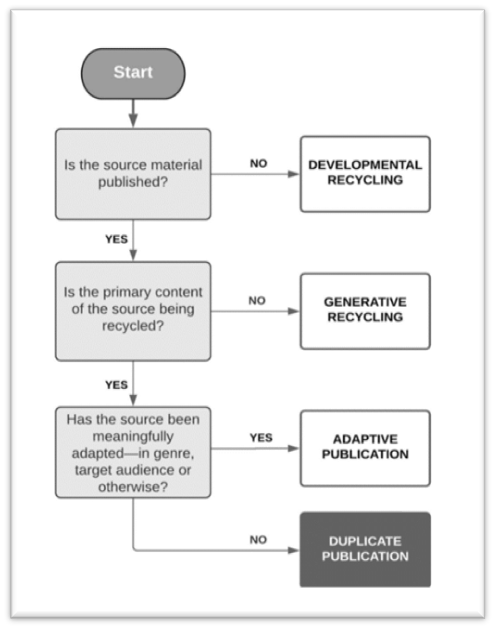
There are indeed situations where you may want to partially or completely reuse material from your previous publications, and where this also may be fully legitimate. In other situations, text recycling would be problematic. Below is a brief overview of the most common types of text recycling and an assessment of them. The typology is drawn from the “Text Recycling Research Project” by Susanne Hall, Cary Moskovitz and Michael Pemberton (2021).
- Developmental recycling is the reuse in a publication of content or ideas from previously finalized, but unpublished texts such as conference posters, presentations, abstracts, unpublished manuscripts, pre-prints, grant proposals, or written exams. Including your own materials of this kind in an article or a monograph is considered legitimate.
- Generative recycling is the reuse of portions of a previously published document in a new work, where the latter can be considered a new, original intellectual contribution, clearly distinct from your previous publication. Your new publication must provide new, substantive insight, even though it in some of its parts reuses previously published content. The latter could for instance be methodological descriptions, citations from data/materials, or contextual information. Make sure to reference your earlier publications properly.
- Adaptive publication is a form of text recycling which implies the republication of a work’s main content in a different context, for a different readership and/or in a different genre. Adaptive publication may include the republication in another language of a published article, the adaptation of a research article to make it accessible to a broader segment of readers, or the revision of an article into a book chapter in for instance a textbook. This practice may be considered acceptable if the author is transparent vis-a-vis editors and readers. Permission from copyright holders (the initial publisher) is usually necessary.
- Duplicate publication is the republication of a work’s main content for a similar readership and in the same genre. COPE defines redundant/duplicate publication as "The publication, or attempted publication, of whole or substantial parts of work/data/analysis that have already been published (or have been submitted elsewhere), without transparency or appropriate declaration/referencing." This category includes submitting a similar or adapted version of an already published article to another journal as a new work. This kind of text recycling is generally considered questionable, unethical, potentially also illegal with regard to earlier contracts and transfer of copyright, as it presents previously published work as a new contribution.
Source: Hall et al., 2021. Republished here with kind permission from its authors.
The guidelines formulated by the Norwegian committees for research ethics clearly state that good citation practice involves not only properly referencing other people’s work, but also your own – including when reusing parts of your previous publications. While insufficient references to one’s own work might not be regarded as academic misconduct in the way ordinary plagiarism is, it would be an example of sloppiness and questionable research practice. It is acceptable and even legitimate to reuse in order to develop your ideas, but be transparent about what you do.
Some special categories:
- Conference proceedings may or may not be considered academic publications, depending on the status of the proceedings. In most disciplines it is acceptable, even recommended, that conference proceedings are adapted and/or developed into journal articles. This could be regarded as an adaptive publication. In some disciplines, however, e.g. computer sciences, conference proceedings are often the final scientific product and subsequent republishing of your paper in a journal would be considered duplicate publication. If you are in doubt, check if the conference proceedings in question is registered in the Norwegian Register for Scientific Journals, Series and Publishers.
- Pre-prints refer to manuscripts that researchers upload on public servers before peer review and publication. Most publishers do not regard pre-prints as a publication strictly speaking and thus accept them for publication, but they should be accompanied by a disclaimer.
- Dissertations resemble published works in that they are often made available in institutional repositories and are indexed with metadata in databases. This goes for both monographs and article-based dissertations, which include published work (journal articles) and an extensive introductory synopsis chapter (kappe). In the case of monographs, it has been common in the humanities and social sciences to revise the dissertation after the defense and publish it as a book. This kind of text recycling may be seen as adaptive, even though it would still be aimed at a similar (but potentially broader) audience than your dissertation. In any case, the golden rule of text recycling applies: Make sure to acknowledge that it is a revision.
With the increasing commercialization of the publishing industry and the huge increase of funding spent on APCs as a result of Open Access policies, there are many players out there who are interested in your publications. While serious publishers may not send you flattering invitations to publish as predatory journals do, there have also been cases of bad quality control among established journals. Such tendencies, in combination with an increasing expectation by institutions and authorities of researchers to publish more, may lead to an increase also in duplicate publications.
Salami slicing
Salami slicing is a metaphor for “slicing up” research results in very thin entities across more publications than appropriate, in order to increase the number of your publications. COPE defines salami slicing or salami publishing as “dividing data or research findings into their smallest publishable units to increase the author’s publication output.”
Salami publishing overlaps with duplicate publishing and may be seen as a related and yet different practice, with a somewhat lesser degree of redundancy. Salami publishing means artificially splitting up your research and research output into more pieces than necessary. This implies that each publication can hardly be said to offer new insight or contribute to our common knowledge when seen in the context of your other publications.
Journals and publishers often have their own guidelines in order to hinder salami publishing. The publisher Elsevier states that you should avoid “inappropriately breaking up data from a single study into two or more papers.” At times, however, it can be difficult to draw a clear distinction between what is appropriate and inappropriate in this regard. The same data set (sources) may answer different research questions and be approached by means of different theories. Reusing data is likewise an objective of Open Science. However, the important thing is precisely that your new research question differs significantly from your previous ones or from any other’s, so that your new study truly expands our common knowledge.
In any case, make sure to refer properly to your own, previous publications if they overlap thematically and if your current one develops further ideas you have previously written about. Full transparency in terms of exact referencing is the way to avoid suspicions, be they about self-plagiarism, duplicate publishing or salami slicing.
Useful resources
https://www.forskningsetikk.no/en/guidelines/
'' | COPE: Committee on Publication Ethics (containing both cases and position statements)
References
Hall, S., Moskovitz, C., Pemberton, M. (2021) Understanding Text recycling. A guide for Researchers. Text Recycling Research Project, V.1. https://textrecycling.org/resources/
Moskovitz, C. (2019). Text recycling in scientific writing. Science and engineering ethics, 25(3), 813-851.